

Pair Every AI Dollar With the Value It Is Meant to Create.
AI Spend Governance answered whose spend each AI dollar is. The AI Value Board answers what value that spend is funded to produce, and which investments are worth scaling, which are marginal, and which have no declared value at all.
The AI Value Gap
Attribution answers whose spend it is.
It does not answer why it is being funded.
Most organizations fund AI workloads with a rough estimate and a hallway conversation. The original reason the workload was funded is never captured, never preserved, and gone by the next review.
Why are we funding this AI workload, and what is it supposed to return?
Which of our AI investments are worth the spend, and which are not pulling their weight?
When we approved this workload six months ago, what did we expect it to deliver, and is that still the plan?
The FinOps Foundation is explicit: the discipline must move from cost-per-token to value: pairing cost with the outcome it supports. But most approaches to "AI value" require ingesting business results from CRM, product analytics, or a data pipeline. That is heavy, invasive, and inconsistent with an AWS-native architecture that keeps data in the customer estate.
FinOps Center takes the AWS-native path: capture the declared business case at the moment a workload is funded, preserve it as a durable baseline, and pair it against attributed cost, without ingesting a single outcome from an external system.
A business case is a declared, planning figure.
It is not a measured or realized outcome.
Spend is real, attributed from CUR. The opportunity is asserted by the budget owner. Every value vs. cost view pairs a measured number with a declared one. This is not a weakness to hide. It is what makes the capability credible to a FinOps practitioner. Competitors who claim to measure AI ROI are either ingesting your business data into their platform or hand-waving. FinOps Center is precise about what is declared vs. what is measured.
- Declared value
- Intended value
- The opportunity this workload is funded to pursue
- Investment Prospect
- Planning figures
- Declared opportunity vs projected estimate
- ROI
- Realized return
- Proven value
- Measured outcome
- We track your AI returns
- Cost Saving and Revenue Driving summed together
Business Case Capture
Captured at funding time.
Not reconstructed at review time.
The business case is captured when the Product Owner submits a Business Request or adds a workload in Spaces, at the same step as the cost estimate. It is optional and non-blocking: it never prevents a workload from moving forward. But workloads without one surface as Unbacked AI Workloads in the Allocation Gaps view.
A process, tool, or vendor the organization currently pays for, and expects this AI workload to partially or fully replace. The declared saving is a planning figure: it represents the reduction the team believes is achievable.
A revenue stream the AI workload is intended to grow or protect: higher conversion, expanded capacity, reduced churn. The declared opportunity is the uplift the team believes is achievable, not a guaranteed number.
A bare percentage misleads. “5% of $1M” beats “50% of $50K” but looks smaller without the magnitude. Anchoring on the current-state dollar figure keeps the order of magnitude honest. You see the size of the prize, not just the percentage. Cost Saving and Revenue Driving are always shown separately. They are different kinds of dollars and are never summed.
Durable Baseline
The original intent is always visible.
A revision never overwrites the baseline.
Editing a business case appends a new snapshot. The original is frozen as a baseline. A Revised marker appears when a case has changed, with the original always visible beside it. A budget owner who quietly inflates a value to flatter a ratio is visible, because the original is right there.
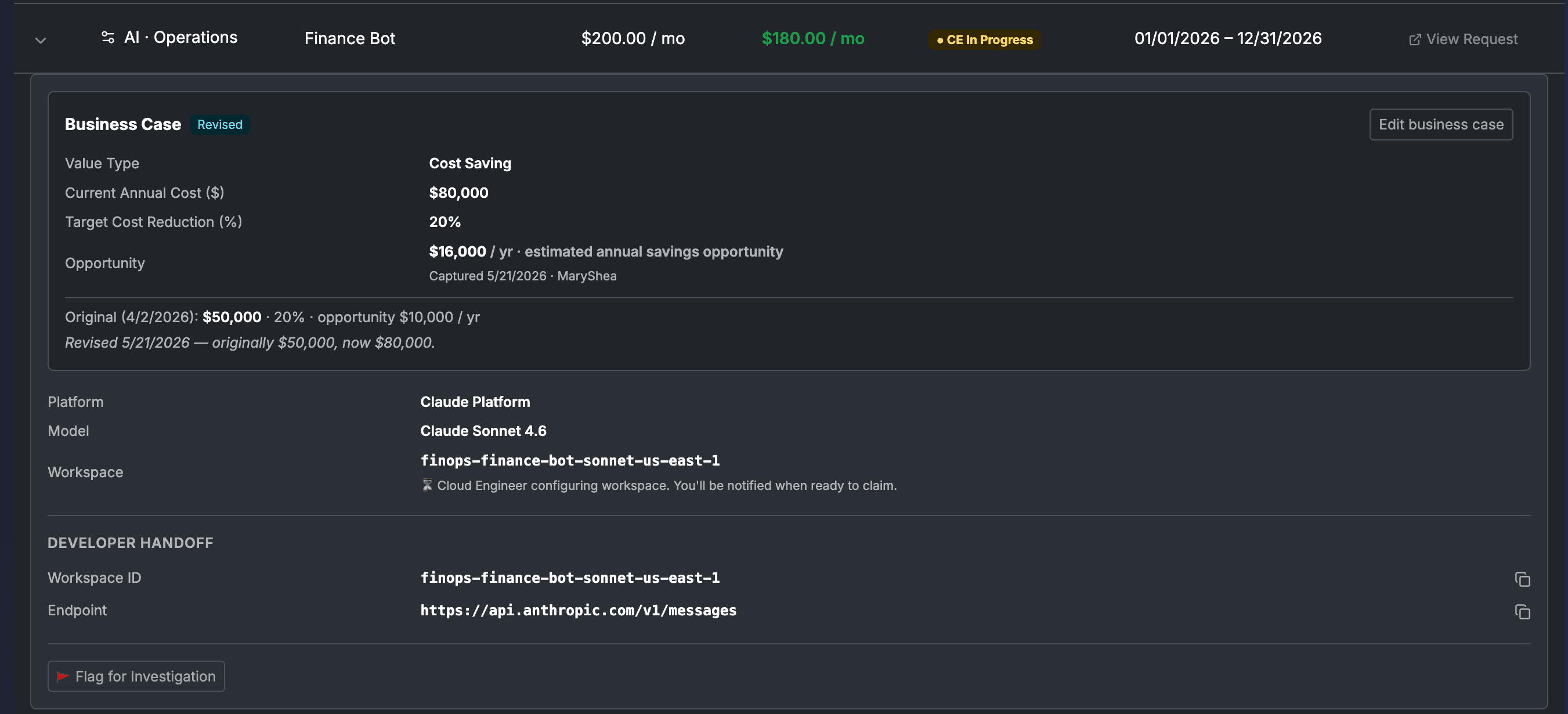
Business Case detail: Revised marker, current figures, and original baseline always visible. Every version carries a timestamp and the identity of who captured it.
Editing a business case never overwrites it. Each change appends a new snapshot with a timestamp and the identity of the person who made it.
When a case has changed, a Revised badge appears on the workload detail. The original capture date, amount, and percentage are displayed alongside the current figures.
At any budget review, the original declared intent is right there. No reconstructing what was originally promised. Compare against the baseline, not a guess.
Business Case at the Approval Gate
Value reviewed before funding.
Not after the fact.
When a Financial Admin reviews a Business Request, the declared business case is part of the decision. The FinOps Foundation describes this as the AI Investment Council intake process: expected value reviewed before funding, so the value is agreed, not just asserted.
The acknowledgement is stored alongside the approval rationale. At any future budget review, the record shows not just that spending was approved, but what value it was approved to pursue.
AI Value Board
AI spend stops being a flat bill.
It becomes a portfolio you can reason about.
Every AI workload rendered as a tile: sized by what it is planned to cost, colored by how its declared value compares to that cost. One screen shows the shape of the AI portfolio: the strong bets, the marginal ones, and the workloads nobody has declared a reason to fund.
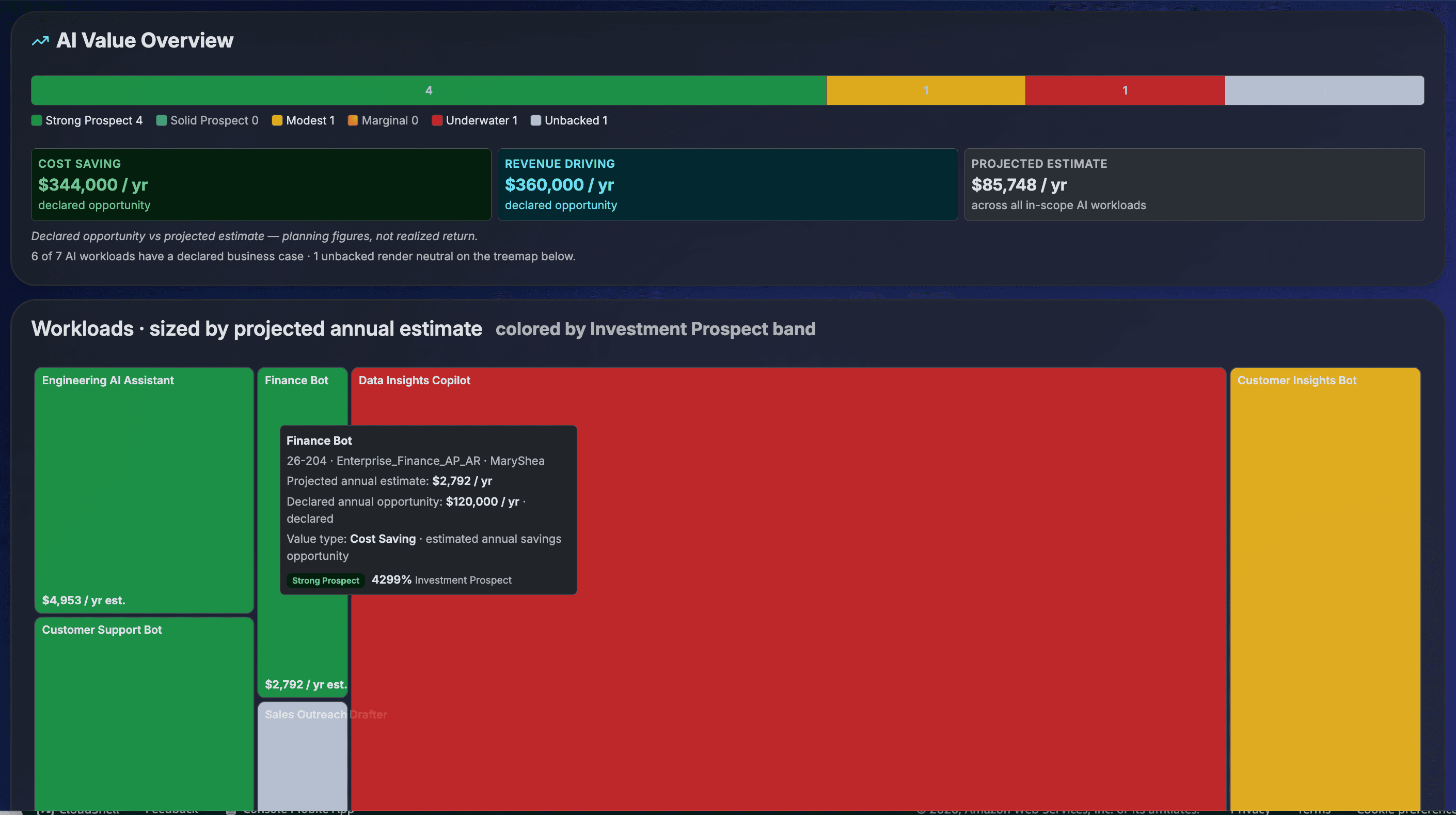
Workloads sized by projected annual estimate, colored by Investment Prospect band. Hover any tile to see declared opportunity, projected cost, value type, and Investment Prospect score.
Declared annual opportunity significantly exceeds projected annual cost. A clear candidate to scale.
Declared opportunity comfortably above projected cost. Tracking well; worth monitoring for growth.
Declared opportunity above projected cost, but not by much. Worth reviewing whether scope should expand or contract.
Declared opportunity barely clears projected cost. The business case may need revisiting before the next funding cycle.
Projected cost exceeds the declared opportunity. The case for continued funding is weak unless the business case is updated.
No declared business case. Real spend or a set estimate exists, but nobody has declared what value this investment is funded to produce.
Unbacked AI Workload
Real spend. No declared reason to fund it.
A workload with real spend or a set estimate but no declared business case is the cleanest governance gap on the Value Board: dollars going toward a workload nobody has declared a reason to fund. It renders neutral (grey) on the treemap, so the gaps are obvious at a glance.
Finance cannot tie the spend to an intended value. The workload owner has not declared what this AI investment is funded to produce. This is an Allocation Gap, surfaced in the Allocation Gaps view with a direct action to request the business case from the owner.
Value in the Governance Maturity Score
An estimate without a declared value
is no longer fully mature.
The Estimate Coverage dimension in the AI Governance Maturity model now blends estimate coverage with business case coverage. Reaching the Run tier requires estimates paired with declared value, not just estimates present. This mirrors the FinOps Foundation's own arc: attribution, then planning, then value.
What percentage of claimed AI workloads have a confirmed budget estimate set before spending begins.
What percentage of claimed AI workloads have a declared business case: either Cost Saving or Revenue Driving.
To reach the Run tier: estimates and business cases present for nearly all AI workloads as a matter of routine. A workload with a cost estimate but no declared value is not fully mature.
In R1, the AI Value Board pairs declared annual opportunity against projected annual cost: two planning figures. Projected cost uses the monthly estimate with expected growth and funded period, not a flat multiply. The board is honest about this: both numbers are declared, neither is a realized outcome.
R2 roadmap: pairing declared value against attributed actual spend per workload, once workload-grain CUR data is available end-to-end. That is the move from opportunity vs estimate to value vs real spend. It is not available today and is not marketed as such.
Know what your AI is funded to do, not just what it costs.
The AI Value Board is available in R1. Every Business Request captures the business case. Every approval acknowledges it. Every workload without one surfaces as an Allocation Gap.